Every parent of a neurodivergent child knows the heavy, burning weight of the Public Glance.
It happens in the middle of a crowded grocery store aisle, at a family gathering, or during a simple trip to the park. Your child is suddenly overwhelmed, crying, or completely withdrawing. Within seconds, you feel the eyes burning into your back—the subtle tuts, the raised eyebrows, the unsolicited advice, or the unmistakable side-eye that silently whispers: "Why can't they control their kid?"
That judgment is exhausting. It turns already difficult moments into high-stress survival situations where you're forced to manage your child's distress while simultaneously bracing against the world's misunderstanding.
The core of this stress comes from a fundamental mix-up: the world sees a tantrum where there is actually a meltdown or a shutdown.
Understanding the difference isn't just academic—it’s the key to protecting your child’s emotional well-being and giving yourself permission to ignore the stares.
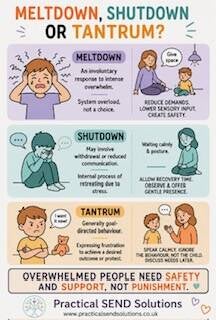
1. Meltdown: System Overload, Not a Choice
-
What it looks like: Crying, screaming, flailing, or intense distress.
-
What is actually happening: An involuntary, fight-or-flight response to extreme sensory or emotional overwhelm. Their nervous system has hit maximum capacity, and the brain is in panic mode.
-
The parent's role: Reduce demands, lower sensory input (lights, sounds, crowds), and create immediate safety. Give them space and time without forcing them to "calm down" on command.
2. Shutdown: The Invisible Struggle
-
What it looks like: Withdrawal, refusal to speak, staring into space, or curling up into a ball.
-
What is actually happening: An internal process where the child retreats because their system cannot process any more input. It is the "freeze" response to stress.
-
The parent's role: Wait calmly and present a peaceful posture. Offer a gentle, quiet presence, allow full recovery time, and refrain from demanding verbal answers until their nervous system resets.
3. Tantrum: Goal-Directed Behavior
-
What it looks like: Anger, protesting, shouting, or bargaining (e.g., "I want it now!").
-
What is actually happening: A conscious effort to achieve a desired outcome or express frustration over a boundary (like not getting a toy or a snack).
-
The parent's role: Speak calmly, set or hold a firm boundary, ignore the behavior without ignoring the child's humanity, and discuss feelings later once everyone is calm.
The Takeaway: Safety Over Judgment
When a child is experiencing a meltdown or a shutdown, they are not misbehaving; they are struggling. They don't need discipline, stern warnings, or public shame—they need co-regulation.
As a parent, your primary job in those high-intensity moments is to be their safe harbor. The stranger in aisle four doesn't know your child's sensory profile, their daily challenges, or their neurotype. Their misinterpretation of your child's brain state is a reflection of their lack of awareness, not your parenting.
Overwhelmed people need safety and support, not punishment.
The next time you feel the weight of public judgment, take a deep breath, tune out the onlookers, and focus entirely on the nervous system in front of you. You are doing the vital work of keeping your child safe in a world that wasn't built with their processing style in mind.