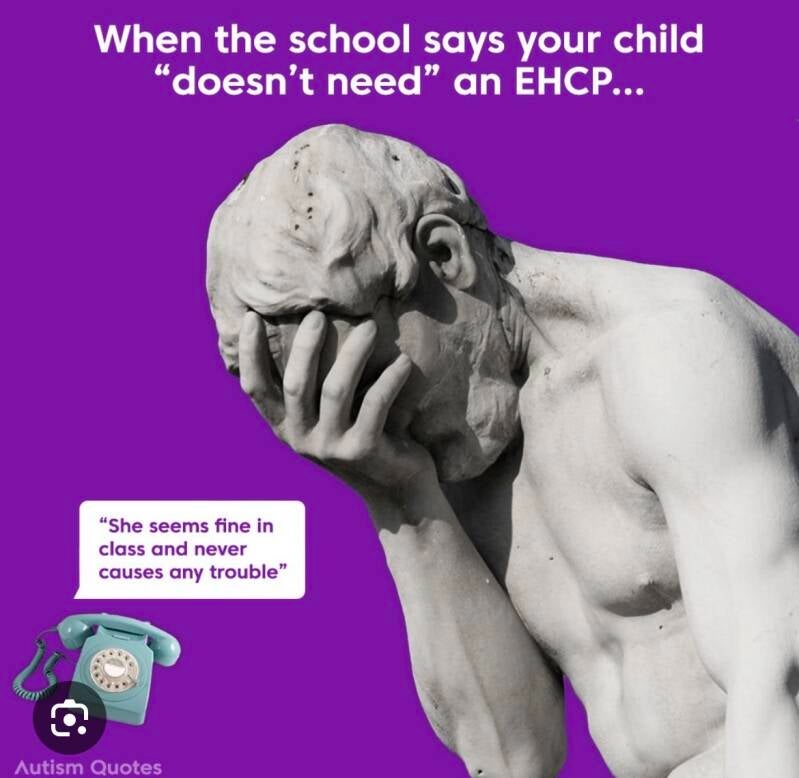
If you are raising a neurodivergent or high-masking child, there is a specific sentence that can make your stomach instantly drop:
"She seems fine in class and never causes any trouble."
It is usually delivered with a reassuring smile by a well-meaning teacher or SENCO over the phone. But to a parent who is watching their child unravel the moment they step through the front door every afternoon, those words feel like a physical blow.
It leaves you questioning your own reality. If they are "fine" at school, why are mornings a battleground of severe anxiety? Why are evenings spent dealing with explosive meltdowns or heartbreaking shutdown? And why does the system insist that unless a child is visibly disrupting a classroom, they don't need an Education, Health and Care Plan (EHCP)?
The Masking Trap: Surviving vs. Thriving
What schools often see in a quiet, compliant child is not a thriving student—it is a child who is masking.
Masking is a survival strategy. Autistic children, particularly girls, often spend their school hours suppressing their natural instincts, forcing eye contact, hiding sensory overload, and copying social behaviors to fit in. They consume every drop of their energy just to blend into the background and avoid standing out or "causing trouble."
By 3:00 PM, their emotional and sensory reserves are entirely depleted. Home is their safe space, so as soon as they cross the threshold, the mask comes off, and the emotional collapse happens.
Because the school environment only sees the "fine" version, they assume the child is coping. But holding it together for six hours a day at the expense of mental health is not coping. It is surviving on borrowed time.
"Fine" is Not the Legal Standard for SEND Support
One of the biggest misconceptions in special educational needs is that a child must be falling behind academically or causing behavioral disruption to qualify for an EHCP assessment.
The legal test for an EHC needs assessment is straightforward:
-
The child or young person has or may have special educational needs (SEN).
-
It may be necessary for special educational provision to be made in accordance with an EHCP.
Notice what isn't in the legal test:
-
It does not say a child must be causing a disruption.
-
It does not say a child must be years behind their peers academically.
-
It does not say a child must be failing in class.
A child who is academically bright can still have significant social, emotional, mental health, or sensory needs that require specialized, legally binding support. Compliance is not a measure of well-being, and high marks do not negate the need for reasonable adjustments and statutory provision.
How to Challenge the "She's Fine" Narrative
If you are stuck in a cycle where the school insists your child doesn't need an EHCP because they aren't "troublesome," here are three crucial steps to take:
1. Document the Home Reality
Schools and Local Authorities rely heavily on written evidence. Start keeping a detailed daily or weekly log of what happens after school:
-
Meltdown frequency and duration
-
School refusal or morning distress
-
Physical symptoms of stress (stomach aches, sleep disruption, tics)
-
The impact on family life and the child's emotional state
2. Request an Independent EHC Needs Assessment
You do not have to wait for the school to apply for an EHCP on your behalf. Parents have the legal right to apply directly to their Local Authority for an EHC needs assessment. When you apply, present your evidence of the unseen impact, mental health struggles, and sensory burnout.
3. Shift the Focus from "Behavior" to "Need"
Highlight that high anxiety and masking are educational barriers in themselves. A child who is constantly in a state of high physiological arousal cannot access learning in a meaningful way, even if they appear quiet on the outside.
You Don't Have to Fight the System Alone
Navigating the EHCP process when your child's needs are "invisible" to the school can be utterly exhausting. You end up feeling like you have to prove your child is struggling, fighting against a system designed around rigid boxes and gatekept resources.
At Practical SEND Solutions, I specialize in helping families make these invisible needs visible. I understand the legal frameworks, speak the Local Authority’s language, and step in to take the heavy lifting off your shoulders—so you don't have to keep fighting this battle by yourself.
Your child deserves a school experience where they can actually thrive, not just a system that ignores them because they are quiet.